

Quick question: can you point to your pelvic floor? If you just did an awkward little wiggle in your chair and thought, “somewhere… down there?” you’re in very good company. Most of us were never properly introduced. Which is wild, because these muscles have shown up for you every single day of your life.
Last month, in our breath series, we met the “core canister”: diaphragm on top, pelvic floor on the bottom. This month, the bottom of that canister finally gets the spotlight.
So What Is It, Exactly?
Your pelvic floor is a group of muscles, ligaments, and connective tissue stretched across the bottom of your pelvis. It runs front to back from your pubic bone to your tailbone, and side to side between your sit bones. Picture a hammock, or a soft, supportive bowl.
It works in layers. The deep layer is the heavy lifter: the levator ani (a trio called the pubococcygeus, puborectalis, and iliococcygeus) plus the coccygeus near your tailbone. The more superficial layers wrap around your urethra, vagina, and anus and handle the opening, closing, and sexual function side of things.
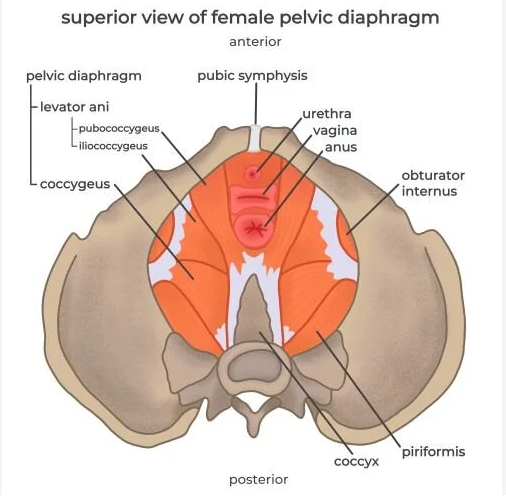
Why It Matters (Like, a Lot)
This little hammock has a big job description:
- Support: It holds up your bladder, uterus, and bowel.
- Continence: It keeps things in until you decide it’s time.
- Sexual function: It plays a starring role in arousal, sensation, and orgasm.
- Stability: It teams up with your diaphragm and deep core to steady your spine and pelvis every time you squat, lift, or scoop up a grandbaby.
- Circulation: It acts like a sump pump, helping move blood and lymph out of the pelvis.
Here’s why this matters at this age & stage of life. Your pelvic tissues are loaded with estrogen receptors. As estrogen declines, those tissues can become thinner, drier, and less elastic, and muscle mass drops across the whole body. Stack that on top of pregnancies, decades of hauling groceries and kids, chronic coughing, or constipation, and symptoms often show up now: leaking when you sneeze, sprinting to the bathroom, a feeling of heaviness, or pain with sex.
So let me say this plainly: common is not the same as normal. Leaking is not a rite of passage. It’s information.
Tune In: Find It First
Curiosity over judgment, always. Sit on a firm chair and feel your sit bones underneath you. Take a slow breath into your belly and lower ribs. On the inhale, notice a gentle widening or softening down there. On the exhale, notice a subtle lift. That’s your pelvic floor riding along with your breath.
Want a clearer signal? Imagine gently picking up a blueberry with your vagina and lifting it an inch. Yes, really. (Please don’t practice by stopping your urine stream mid-pee; that can confuse your bladder.)
Relax It: The Half Nobody Talks About
A strong muscle is one that can contract and fully let go. Plenty of us are gripping all day long: stomach sucked in, jaw clenched, bracing through every stressful email. That’s called an overactive or hypertonic pelvic floor. It can show up as pain with sex or exams, constipation, urgency, trouble starting to pee, or nagging hip and low back pain. For these women, more Kegels can actually make things worse.
Try this: lie on your back with knees bent, or rest in child’s pose. Inhale into your belly and let your pelvic floor bloom open like a flower. Exhale and let it stay soft. Unclench your jaw while you’re at it — the jaw and pelvic floor love to tense together.
Meet Tracy
Tracy is 50 and did Kegels at every red light because an instagram influencer told her to. She still leaked, and sex was getting more painful. Her pelvic floor physical therapist found the surprise: her muscles weren’t weak, they were exhausted from never letting go. Her homework was learning to relax. Within a couple of months, both symptoms had eased.
This week, your only job is to notice. Where do you clench? In traffic? On a work call? While you brush your teeth? No fixing yet. Just discover.
Next time: how to actually train your pelvic floor, how to brace during strength training, and why pelvic floor PT and visceral manipulation deserve a spot on your team.