
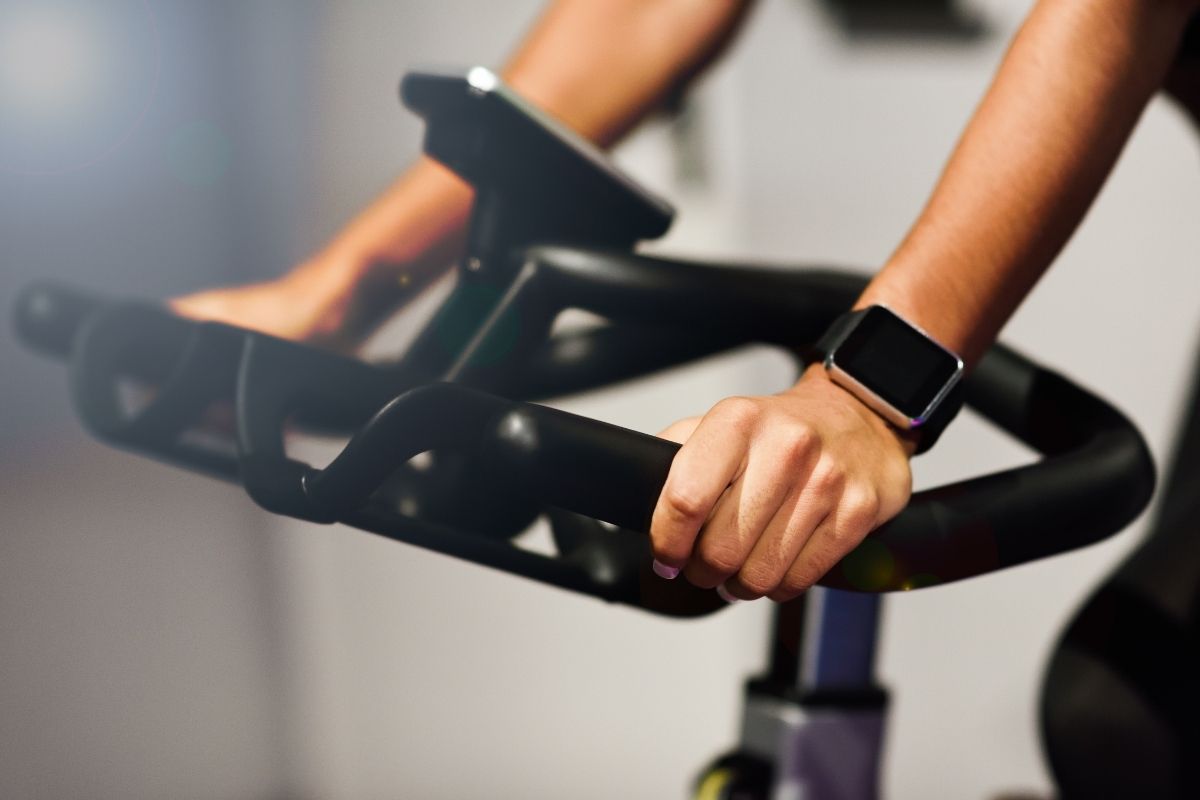
There’s a stretch of effort that feels productive but rarely pays off the way you think it will. It’s harder than a walk, but not hard enough to spark real adaptation. It leaves you tired without leaving you stronger. Exercise physiologists sometimes call it the gray zone. I call it No Woman’s Land — because it’s exactly where so many of us end up by default, without ever choosing it.
What Zone 3 Actually Is
Zone 3 sits around 70–80% of max heart rate — that moderately-hard pace where you could talk, technically, but you wouldn’t want to. It’s the effort of a spin class you’re pedaling through on autopilot, a run that’s not quite a jog and not quite a sprint, an elliptical session at a pace that feels like “working out” should feel.
Here’s the problem: it’s too hard to build the aerobic base that true Zone 2 builds, and it’s too easy to trigger the powerful adaptations that come from true high-intensity work. You end up spending your energy and your recovery capacity on an effort that gives you the worst of both trade-offs — real fatigue, without either payoff.
It also keeps cortisol elevated for longer than a short, hard burst does, without ever fully downshifting into the parasympathetic “rest and repair” state that easy movement allows. Done occasionally, it’s not a problem. Done as your default, day after day, it’s a quiet drain — the kind of thing that leaves you thinking, “I work out constantly, why don’t I feel better?”
The Alternative: Short, Hard, and Genuinely Recovered
On the other end of the spectrum is real high-intensity training — and used correctly, it’s one of the most powerful tools available to women in midlife. The key word is used correctly.
Sprint Interval Training (SIT): Very short, maximal efforts — think 15 to 30 seconds of all-out effort — followed by full recovery, repeated for a handful of rounds. This might look like sprinting on a bike or an incline for 20 seconds, then resting for 2 to 3 minutes, and repeating 4 to 6 times.
High-Intensity Interval Training (HIIT): Slightly longer hard efforts — often 30 seconds to a few minutes — at a very challenging but sub-maximal pace, paired with a real recovery interval. Think intervals on a bike, rower, or a hill.
Both of these live at Zone 4–5 — genuinely hard, genuinely brief, and genuinely followed by rest. That last part is not optional. The magic of this kind of training isn’t the intensity alone; it’s the intensity paired with real recovery, which is what allows your body to adapt rather than just accumulate fatigue.
Why This Matters for Your Hormones
Research on women in perimenopause and menopause has found real benefits from properly dosed high-intensity training: improvements in insulin sensitivity, cardiovascular fitness, and even bone density — all things that become more of a priority in this age & stage of life. But the dose matters enormously. This is one to two short sessions a week, not five. Done to excess, or without adequate recovery, it stops being eustress and starts being just… more stress on an already taxed system.
Meet Lindsey
Lindsey, 46, used to fill every workout with the same moderately-hard cardio class, five days a week, because it felt disciplined. When she swapped three of those sessions for easy walks and replaced the other two with just 15 minutes of true intervals — a handful of hard 30-second pushes with full recovery between them — she was doing less total “hard” cardio and getting better results. Less No Woman’s Land, more of the two zones that actually deliver.
Next week, we bring it all together: exactly how much of each type you need, and how to realistically fit it into a life that is already full.